Leading global fashion and lifestyle company with premium positioning
Portfolio strategy with two unique brands – BOSS and HUGO
Strong global footprint with ~8,000 points of sale and >70 digital markets
Business activities
HUGO BOSS AT A GLANCE
Full-time equivalents (FTE).
HUGO BOSS, headquartered in Metzingen (Germany), is a leading global fashion and lifestyle company in the premium segment, offering high-quality women’s and men’s apparel, shoes, and accessories. The Company pursues a portfolio strategy, with the HUGO BOSS platform currently consisting of two globally renowned brands – BOSS and HUGO. While both brands are clearly distinguished by individual characteristics such as design and fit, they share equally high standards in terms of quality, innovation, and sustainability. In fiscal year 2025, HUGO BOSS generated sales of EUR 4.3 billion (2024: EUR 4.3 billion). Earnings development
As a 24/7 lifestyle brand, BOSS offers outfits suited for every occasion across four distinct brand lines. The largest, BOSS Black, focuses on modern tailoring and smart casualwear for men and women, while the exclusive BOSS Camel line emphasizes high-end tailoring heritage for menswear. Casualwear products are mostly covered under BOSS Orange, while BOSS Green focuses on athleisurewear designed for an active lifestyle. HUGO focuses on a broad range of contemporary and streetwear-inspired products, reflecting the brand’s authentic and unconventional style. Group Strategy, Brand Excellence, Distribution Excellence

Shaping Brand Excellence
With CLAIM 5 TOUCHDOWN, it’s time to further elevate BOSS and HUGO, continue shaping what our brands stand for, and strengthen their positioning as truly desired global brands.
Learn more Learn moreIn addition to a broad product offering within the seasonal BOSS and HUGO collections, capsule collections and collaborations increase the relevance of our brands. To elevate brand equity and drive customer loyalty, we pursue two clearly distinguished marketing strategies for BOSS and HUGO, with a strong focus on social media. In this context, we put particular emphasis on key partnerships, product-led campaigns, and high-profile brand events. Group Strategy, Brand Excellence
Design and development of our brands’ collections is mainly carried out at our headquarters in Metzingen (Germany), while our development centers in Coldrerio (Switzerland) and Morrovalle (Italy) are responsible for specific product groups. In addition, we have granted licenses for the development and distribution of products including fragrances, eyewear, and watches. To increase speed-to-market capabilities and shorten the product development process, the majority of our products are developed digitally. Product Development and Innovation
In fiscal year 2025, HUGO BOSS produced 17% of its total sourcing volume at own facilities (2024: 20%). All five own production sites are located in Europe, with Izmir (Turkey) contributing the largest share. The remaining 83% of sourcing volume was sourced from external contract suppliers or as merchandise (2024: 80%), primarily from partners in Asia and Europe. Business Operations, Combined Non-financial Statement, Workers in the Value Chain
We pursue an omnichannel strategy aimed at delivering a seamless brand experience across all consumer touchpoints, including brick-and-mortar retail, wholesale, and digital channels. Consumers can experience and purchase BOSS and HUGO products at around 8,000 brick-and-mortar points of sale globally (2024: more than 8,000) and in 74 markets via hugoboss.com (2024: 74 markets). Group Strategy, Distribution Excellence, Consumer Touchpoints
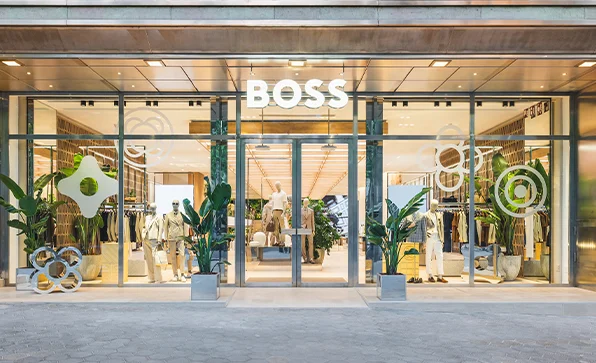
Shaping Distribution Excellence
Excellent brands deserve excellent stages. That’s why we continue to shape every moment where consumers experience BOSS and HUGO – not only showcasing our brands but make people feel them.
Learn more Learn moreIn 2025, BOSS and HUGO products were distributed across 128 countries (2024: 129), with distribution divided into three sales regions. EMEA (Europe, Middle East, and Africa) represents the largest, accounting for 62% of Group sales (2024: 61%). The Americas and Asia/Pacific contributed 23% and 12%, respectively (2024: 24% and 13%), while licensing accounted for the remaining 2% (2024: 3%). Earnings Development, Sales and Earnings Development of the Business Segments
Digitalization represents a key enabler for implementing our vision of being the leading premium tech-driven, customer-centric global fashion platform. In this context, we drive the digitalization of our business activities and leverage the power of artificial intelligence (AI) along the entire value chain. AI is increasingly embedded across key business processes, supporting design and product creation, production and sourcing, demand forecasting, marketing effectiveness, and distribution and logistics, thereby enabling higher transparency, improved planning, and smarter decision-making.
Sustainability is essential to our corporate responsibility and business activities. Our Sustainability Strategy, which was updated in 2025 is based on five key pillars: increasing circularity, driving digitization and data analytics, leveraging better natural materials, shifting to better polyester and polyamide, and reducing climate impact. In addition to environmental protection, we also put a focus on socially responsible production pro-cesses while maintaining the high quality and durability of our products. Group Strategy, Sustainability Strategy, Combined Non-financial Statement
We strive to further strengthen our attractiveness as an employer in fashion. Our human resources (HR) strategy focuses on attracting, retaining, and developing top talent. The passion and dedication of our more than 17,500 employees worldwide (2024: over 18,500) are vital to the successful execution of our strategic ambitions. In this context, we are committed to a performance-oriented company culture built on trust, guided by our values entrepreneurial spirit, personal ownership, team mentality, simplicity & quality, and youthful spirit. Combined Non-financial Statement, Own Workforce
Group structure
HUGO BOSS is managed by its parent company, HUGO BOSS AG, which as a German stock corporation, operates under a dual management and control structure. Accordingly, the Managing Board is responsible for steering the Group and successfully executing its strategy, while the Supervisory Board oversees and advises the Managing Board. The two boards are strictly separate in terms of both composition and responsibilities yet work together closely in the best interests of the Company. The Group comprises HUGO BOSS AG and 59 consolidated subsidiaries, including 39 distribution companies and four production-focused subsidiaries, each responsible for their local business activities. Notes to the Consolidated Financial Statements, Basis of Consolidation
HUGO BOSS is structured by region, with our business segments being EMEA, the Americas, Asia/Pacific, and the license business.
|
|
Managing Board |
||||||
|---|---|---|---|---|---|---|---|---|
Central departments |
|
Brand Management/Business Units |
|
Internal Audit |
||||
|
Business Operations |
|
Investor Relations |
|||||
|
Business Planning & Analysis/Risk Management |
|
IT |
|||||
|
Construction |
|
Legal/Compliance |
|||||
|
Corporate Communications |
|
Logistics |
|||||
|
Design/Creative Management |
|
Marketing |
|||||
|
Finance/Tax |
|
Omnichannel |
|||||
|
Group Strategy |
|
Procurement |
|||||
|
Human Resources |
|
Wholesale |
|||||
Operating segments |
|
EMEA |
|
Americas |
|
Asia/Pacific |
|
Licenses |
Hubs |
|
Northern Europe |
|
Americas |
|
China |
|
|
|
Central/Eastern |
|
|
|
||||
|
Western Europe |
|
|
Southeast Asia/ |
|
|||
|
Emerging Markets |
|
|
|
||||
The central departments of HUGO BOSS AG cover key parts of the value chain, particularly the design and creative management, product development, production, sourcing, and distribution of our collections to the respective markets. Our Group strategy is executed on a market level in order to ensure strong customer focus and agile responses to market-specific developments. The markets are grouped into hubs, with local management reporting directly to the Chief Sales Officer (CSO), enabling close alignment with central functions and short decision-making processes. In addition, certain functions are bundled within the hubs and central departments across markets to leverage specialist expertise and generate cost benefits.